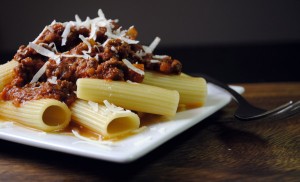
 If you are comfortable cooking by sight and taste, you’ll be happy to know that a recipe, in strict format, isn’t really helpful when making fresh tomato sauce. If you love the step-by-step instructions and no-fail certainty of a recipe, then you might be a little nervous. But, you simply cannot mess up tomato sauce (short of burning it), so this is a good place to start your improvisational career in the kitchen.
Since there is no real recipe, I am going to give a few tips and guidelines culled from my experience. Please feel free to add other helpful thoughts in the comments section. Cooking is nothing if not the result of accrued wisdom.
- Fresh tomato sauce is a great way to use up tomatoes when they’re growing faster than you can eat them. And it’s the perfect place for soft, bruised, overripe ones.
- Roma, or paste tomatoes, make for nice, rich sauce. But if you don’t have them, your average garden-variety tomato will work, you’re just going to have to work a little harder.
- Bring a large pot of water to boil, and prepare a large bowl of ice water.
- Cut out any rotten or moldy parts and lightly score an “X” on the bottom (not stem side) of the tomato.
- A few at a time, drop the tomatoes into the boiling water for about 20-30 seconds. Remove them from the pot with a slotted spoon and transfer them to the ice water.
- Peel, seed, and dice the tomatoes. (Since I don’t like to waste anything, I save the juice and seeds and strain it—saving the juice and discarding only the seeds.)
- Transfer about 1/3 of your diced tomatoes to a blender or food processor, and process into a thick puree. (This helps thicken the sauce. This step is a must if you are not using paste tomatoes.)
- Meanwhile, if you are making meat sauce, brown the meat in a large pot or Dutch oven. When the meat is brown, remove it from the pot and set it aside.
- Chop a medium-large onion (and maybe a carrot and celery stalk), and mince 2-3 large cloves of garlic. Heat 2-3 tablespoons of olive oil in a large pot or Dutch oven. Add the onion (and carrot and celery) and sauté until soft, then add the garlic and continue to sauté until fragrant. If using meat, return it to the pot. If you’d like to add red pepper flakes or dry herbs (basil, oregano, thyme, etc), add them now.
- Deglaze the pot with a heavy splash of red wine (about ½ cup). Add the diced tomatoes and the tomato puree to the pot, season with salt and pepper and simmer.
- Continue seasoning and simmering–adding more salt, pepper, or wine as needed–until the sauce has reached your desired consistency. (If you are planning to freeze the sauce, I would suggest making it a little thicker than you normally would since sauce tends to thin a bit when thawed.)
- When the sauce is just about done, add any fresh herbs you’d like. And if you’d like to add cream or milk, do so at this point and cook for a few more minutes.
- If you’re not eating the sauce immediately, allow it to cool and transfer it to freezer bags or containers. It can be frozen for up to 3 months with meat, and 4-6 months without meat.

ooof, you are committed! Sounds so yummy though!
Love the *wonderfully detailed tips, steps, yet also ‘looseness’ (and many ideas for substitutions/variations) of your recipe.
My mantra (thanks to you gals)… I am the chef of my kitchen. 🙂
Fresh tomato sauce is the best!
I just made tomato sauce for the first time yesterday! I wish I had had these tips…will definitely bookmark this for the next time I make sauce!
My mouth is watering just looking at the photo…yum! In my opinion, there’s nothing better than fresh tomato sauce. I could probably eat it every day!
Great story…and I’m jealous; haven’t had a supply of enough tomatoes for years to bother canning my own. But nothing better in my book. You could trade for cigarettes in jail.
Love all of these great tips on making a basic tomato sauce!
I just made fresh pasta sauce today and froze it. You don’t actually even need to score the tomatoes with an x, you can just rinse them and put them in the boiling water. When the skin splits, dip them in cold water. Then just slip the skin off, core and seed them. Also an immersion blender works really well for not having to transfer the tomatoes around or even dice them for that matter. (unless you want some diced tomatoes in your sauce).
You are correct, beyond burning, tomato sauce is easy to make and fun to experiment with.
I am up to my ears in tomatoes. I’ll be making this sauce this weekend! Thanks Sharon
I’ve always wanted to try sauce from scratch if for the bragging rights alone, ‘Well actually, I did make the sauce from scratch’.
Thank you !!!
The only suggestion I have is that you add a scale of approx. how many tomatoes make how much sauce.