 The other day David came home from the office with a handful of papers. “What’s that?” I asked. His response was a little sheepish: “Umm. I was thinkin’ we might serve Simnel cake after church next Sunday. He stammered a little as he continued, “I found some recipes online. Could you look at them and maybe pick out the best one?”
I had heard of Simnel cake, probably even eaten a slice or two at some point, but there are lots of religious holiday sweets. Like the Three King’s Cake with a ceramic baby Jesus baked inside on the first day of Epiphany and the gaudy donut-shaped cake with green, purple, and gold sugar for Shrove Tuesday. (Apparently these two cakes are actually the same.) There are Advent stollens, hot cross buns, egg bread.
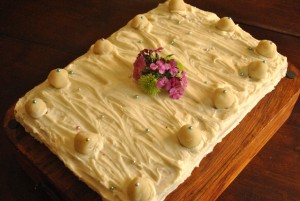
As it turns out, Simnel cake has evolved into an Easter confection, but there was a time it was served on Laetare Sunday (“Refreshment” Sunday), the midpoint between Fat Tuesday and Good Friday. It was a little treat for the Lenten-weary. It was also known as Mothering Sunday. Servant girls would get to visit their mothers on this day and bring a cake. They’d decorate the cake with eleven almond paste balls to represent the faithful Apostles (poor Judas didn’t make the cut) and little spring flowers they’d pick en route.
David was preparing for Laetare Sunday at St. Luke’s, and here he was with a fistful of random recipes. But I wouldn’t give the poor bakers in our parish a recipe I hadn’t tested first. Once I did a little research, I realized this cake not only needed testing, it needed serious updating!
Many of the recipes called for archaic size pans. Some recipes contained serious errors. Did the recipe writer really mean to call for 1/2 cup golden raisins and 3/4 teaspoon currants. Was I really supposed to bake the cake for 3 hours? 2/3 cup grated citrus zest? My mouth puckered painfully. A lot of recipes insisted on making your own almond paste. Others called for candied cherries and citrus. About now all I can think of are fruitcake jokes.
So I went to work. I didn’t want to cheapen a cake so rich in tradition, but I didn’t want to turn off potential bakers with weird ingredients, odd pans, and unnecessary steps. I also didn’t want them to waste their time making a cake people might admire but politely refuse.
I started with the pan, developing a recipe that would work in a standard 13- by 9-inch pan. I replaced all the candied fruit with a mix of golden and dark raisins and dried cranberries, and for the candied citrus I substituted a reasonable amount of orange and lemon zest. Rather than rely strictly on eggs for lift, I added a little baking powder to the mix. I left the almond paste layer baked in the middle of the batter but opted for almond flavored butter cream rather than a second layer of cloying almond paste on top of the cake.
I garnished the cake with the traditional almond paste balls but I increased the number to twelve because I think Judas was no worse than the other failed disciples, and much like the cake, the theology needed a little update too.

While the original of this sounds better than the typical fruit cake, the other day I had a long discussion about fruit cake with a few friends. The question popped up of why? What’s the point of the nastiness of it all? And what a waste of good ingredients.
This looks good though – I’m sure everyone will be very thankful you made the effort to update.
And no doubt about the balls, either none or all.
When I see this cake I want to ask you, “What do you mean you’re not a baker?” This cake is perfection. And I can say so because I’ve had it…twice! But thank goodness you updated it, otherwise I’m afraid this recipe would have gone the way of the dreaded Christmas fruit cake. I can’t think of a better cake to serve around Easter. Good fun and conversation to tell the story of this cake around a dinner table.
What a GIFT this recipe is! I had wanted to attempt a Simnel Cake this year, and tried gathering recipes online, but virtually all were in metric measurements, and/or called for ingredients I’d never heard of. I finally gave up. What a great surprise to click into ThreeManyCooks and find your fine-tuned recipe right here — thank you. (I imagine Judas would be more than a bit grateful to you too)
Pam–cant wait to try this cake. Thanks for doing all the research and updating it. It looks wonderful. Let you know how it turns out!
I’m so glad I’ve grown up…and that my palette has too! In the not-too-distant history I would’ve taken one look at this dense, marzipan and dried fruit-studded cake and been like “No, thanks!” But these days, I’ll try anything and thank god, too, because this cake is gooooooooood.
I am not usually a butter cream fan, either, but almond butter cream is a total revelation! This cake is tasty but sophisticated, and I like that you only need a small piece to feel satisfied. It’s so good alongside a good strong cup o’ coffee.
Since my pignoli adventure TANKED, I think I’ll try simnel cake instead next time I’m feeling a hankering for almond paste.
(Oh yeah, and I fully approve of adding Judas to the cake! He was just doing what he was supposed to! Anyone who’s seen ‘The Last Temptation of Christ’ would totally agree that Judas deserves an almond paste ball just as much as Doubting Thomas and Deny-Three-Times Peter!!)
Thanks Pam! I’ve wanted to make a Simnel cake for several years, but (like you) was a bit overwhelmed by the options out there. I’ll give this a try – looks great!
Sounds delicious! Making my tummy rumble and it’s only 9.30am, a long time till afternoon tea and cake 🙂
Hi Pam- Greg here- I wrote you a couple times on your North Carolina blog- the one for the race. Just curious – have you kept all the weight off you lost? Hope that isn’t rude- looking forward to your next cookbook – have been using your last one – the one that talked about weight loss.
Thanks!
Greg
Hi Greg,
Not sure the exact statistic, but the odds are pretty high that people who lose weight won’t keep it off. I, however, am happy to report that I’ve maintained my weight loss for nearly five years!
The new book–Perfect One-Dish Dinners–is out this September. Glad you found us here, and hope you keep visiting.
That is encouraging – very cool- are you pretty much doing the same routine that you talk about in the book? Sounds like you are running more.
I, like you – tried and have read every crazy diet book out for the public. My Dr. would like me to drop 25 pounds – am trying to get off a statin. I only ever think of joining weight watchers sometimes just for the support but can’t really afford it – I bet you tried that one too!
Would you ever consider a place on this blog where folks like me could “meet” – sort of a virtual support group- not sure if it would work but we could have a regular “meeting” time and post a regular blog post at that time … just a thought let me know what you think. I think the support and accountability can help. I am using your cookbook for recipes as they always turn out fantastic and I am sooo tired of cookbooks that don’t work – very frustrating.
By the way – I grew up in south Jersey and went to New Hope, PA often – love that area!
Thanks!! Greg
Greg,
Will bring up the virtual weight loss support group idea at our next Three Many Cooks meeting. It would require a little site redesign but we’ll talk about it. If others are interested (like people are really going to look for weight loss support in a cake post!), speak up.
Hey thanks- I know it must be a group decision and I understand either way – but I think it would be extremely helpful and dare I say – fun! Not just about food but exercise too – might have to consider putting it under its own post for people to see it – plus like you said under a cake posting and all … thanks for considering.
Love the blog.
Best-
Greg
Hi Pam- I am cooking out of your newest book “The Perfect Recipe For Losing Weight…” almost all the time – so, I was wondering if your other cookbooks would work too? I would like to try some of your other books but weight loss and running are now a focus – if I mix the recipes with your weight loss philosophy (which seems to be working for me too, thanks) it all should be good – right? Thanks!!
What a fascinating post! I love the history behind it and hearing about the archaic measurements. I had actually never heard of a simnel cake before reading this post, but now I’m dying to try it.
Cookie disaster! I am not sure what I did wrong… I made the chocolate-coconut cookies (used unsweetened coconut) and they were a huge mess. I used aluminum foil that I sprayed with oil and did the 2 tablesp. mounds – they spread out flat and ran into each other and then stuck to the foil, in the trash now. I managed to get a piece off the foil and it tasted good but what did I do wrong?
I think someone is trying to keep me away from sweets!
Thanks!
Greg
Hey Greg,
Sorry not to have responded sooner. Weather’s been pretty bad up our way. Anyway, I’ve never made these cookies with unsweetened coconut, so that might be the problem. Or, maybe you used evaporated milk rather than condensed? Either way, sorry. I’ve made that recipe several times, so it has to be the coconut or the milk.
thanks for the reply- yes, I saw the weather was bad your way – hope all is OK.
I did use condensed but maybe it was the unsweet coconut… will try again with regular sweetened coconut. Made the creamy pasta with shrimp, spinach and oregano sat. eve – delish.
Pam you are getting me back into the kitchen! I made this Simnel Cake and served it to a group of chaplains, many of whom hadn’t known about Laetare Sunday. Great fun, and the cake received RAVE reviews. Your almond buttercream was a brilliant update — perfect with the rest of the ingredients. I think Laetare Sunday is set to be a “new” tradition in this household 🙂 ps I didn’t have a good 13×9 cake pan, so I used a round 10 inch pan and it worked beautifully, with the almond paste balls circling the perimeter.